
How to protect warranty, safety and project schedule
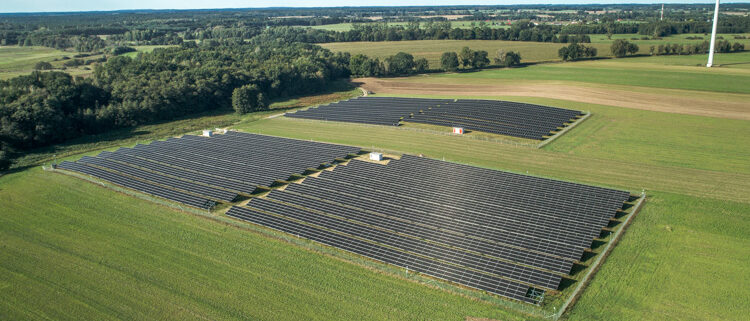
In utility-scale PV projects, wind pressure on PV modules can exceed the limits specified by module manufacturers—especially in Southern Europe. The consequences can be serious: equipment failures, redesigns, schedule impact and even loss of module warranty. At Enson, we verify positive pressure and suction (Pa) early in the design process and run technical alignment not only with investors and EPCs, but also directly with module manufacturers.
Why PV module pressure limits matter
Investors and installers are not always aware that exceeding the allowable loads stated by the module manufacturer can lead to failures and may affect warranty eligibility. In practice, this risk can include glass breakage, frame deformation and internal damage such as microcracks.

What drives suction and pressure on PV modules

As a first step, we check the maximum allowable loads for the selected module and verify both positive pressure and suction pressure, expressed in pascals (Pa). Key factors affecting module pressure include: basic wind load, characteristic ground snow load, system tilt angle, total structure height above ground, National Annexes to Eurocodes, terrain category and orography factors (e.g., mountainous areas and slopes).
Case study: SOLAR FARM in Romania
In one of our ground-mounted projects in Romania, the calculated suction pressure acting on the modules reached 3020 Pa (including safety factors). The module manufacturer defined the allowable suction limit for this load direction as 2400 Pa—meaning the calculated load exceeded the manufacturer’s value by approximately 26%.
How we resolved the exceedance without changing tilt or delaying the project
After identifying the exceedance, we initiated a technical dialogue with the module manufacturer. Based on yield and ROI considerations – and to maintain the original tilt angle assumed in the project – we proposed and implemented a solution using double module mounting (reinforcing brackets and fastening points) without changing the tilt angle. This approach met operational requirements while preserving the schedule and the project’s economic assumptions. No major technical redesign or extended administrative procedures were required.

Warranty protection: compliance with manufacturer mounting guidelines

A critical element of this implementation was maintaining full compliance with the module manufacturer’s mounting guidelines. Following the installation instructions and formal technical alignment with the manufacturer allowed the project to retain the module warranty. Since modules are among the most important – and most expensive – components of a PV plant, early technical validation plays a key role in protecting both safety and the investor’s interests
Alternative approaches: when tilt or orientation changes are viable
In other projects, alternative measures may include adjusting the system tilt angle or changing the plant orientation from south-facing to east-west, if the design phase allows. East-west systems and lower-tilt configurations can reduce effective wind loads acting on modules and may deliver structural cost benefits. Any such change, however, requires a yield impact assessment and an economic analysis.
It is also worth noting that some module manufacturers allow installation on an additional support rail, which can increase maximum allowable module pressure values. While this improves structural performance, it also increases system mass and therefore construction cost – so it is typically used only when other reinforcement methods are insufficient or not feasible.
Why this topic is becoming more important
Climate change – and the increasing frequency of severe weather events, including strong gusty winds – makes correct wind load verification essential. Extreme wind events that were once occasional are now appearing more frequently and with greater intensity.
Ignoring module load verification or using a system that exceeds manufacturer limits can expose investors to warranty loss regardless of whether a future issue is mechanical or electrical. It may also complicate warranty claims in cases of glass breakage, frame deformation or internal damage such as microcracks. From a safety perspective, a detached panel is a serious hazard – debris can damage infrastructure and pose risks to people.
Would you like to verify the loads on PV modules and select a safe structural solution without affecting yields and schedule? Contact us — we will help you choose the solution best suited to your requirements.
Download our case study from a solar farm in Romania.